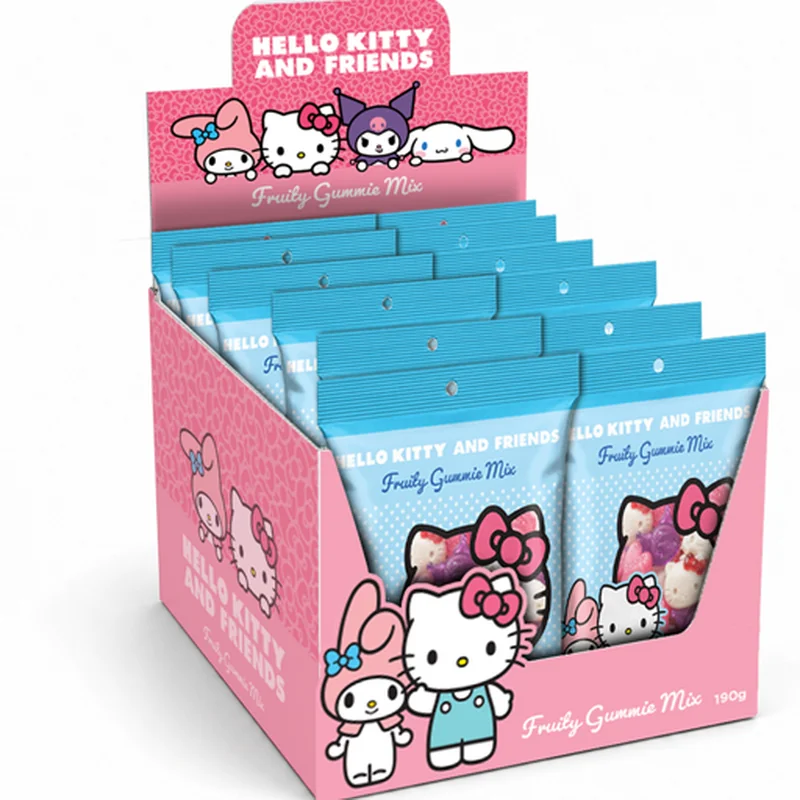
Packaging choices affect how confectionery products travel, how efficiently warehouses handle inventory, and how easily retailers present products to customers. For businesses sourcing bulk gummy candy, the decision involves more than choosing between bags and boxes; material performance, pack size, labeling, and carton configuration all influence the final cost and customer experience. A well-planned packaging specification connects the factory’s production capabilities with the practical needs of distributors, retailers, and private-label brands.
Compare Primary Packaging Formats
Flexible bags are widely used for gummy products because they can accommodate different portion sizes without requiring rigid containers. Depending on the material and closure, they may also offer convenient storage and effective protection against environmental exposure. Buyers should assess seal quality, durability, product visibility, and ease of opening rather than comparing packaging by appearance alone.
Rigid containers and boxes serve different purposes. Boxes can provide a defined presentation area for printed graphics, product information, or gift-oriented designs, while rigid formats may help maintain a consistent shape during handling. Their disadvantages can include greater storage volume and additional material costs. The best choice depends on whether the product is intended for everyday retail, gifting, food-service distribution, or another commercial application.
Product characteristics should guide the final decision. Gummy candies may stick together under unsuitable temperature or humidity conditions, so packaging needs to work alongside appropriate storage and transport practices. Buyers should ask suppliers which materials and sealing methods suit the specific formulation, expected distribution environment, and intended shelf life. Packaging performance should be assessed using actual samples whenever possible.
Match Pack Size to Distribution Requirements
Individual retail packs, multipacks, and larger food-service formats serve different purchasing needs. Smaller packs can make pricing accessible to individual shoppers, while larger formats may suit retailers that sell by weight, event organizers, or businesses that divide stock into smaller portions. Buyers should first identify the intended user and sales method before settling on pack weight and dimensions.
Outer-carton design matters just as much as the consumer-facing package. Cartons need to withstand stacking, warehouse handling, and transportation without excessive crushing or movement inside the box. Dimensions and gross weight also affect pallet arrangement, freight calculations, and manual handling. Requesting carton specifications early helps purchasing teams estimate logistics costs before confirming the order.
The quantity packed into each carton can influence warehouse efficiency and stock control. High unit counts may reduce the frequency of replenishment orders, but they can create challenges for small shops with limited storage. Distributors serving several types of customers may benefit from comparing multiple configurations against their usual order sizes. A practical format should fit the movement of goods through the supply chain, not just minimize packaging cost per piece.
Assess Supplier Quality and Packaging Controls
Reliable packaging depends on both material selection and manufacturing controls. Buyers evaluating gummy candy manufacturers should ask how packaging materials are inspected, how sealing consistency is checked, and how finished cartons are identified by batch. These procedures help establish whether a supplier can maintain consistent standards across repeated orders.
Documentation should reflect the actual product and production arrangement. Depending on the project, useful records may include packaging specifications, material information, batch traceability details, quality inspection results, and relevant third-party testing reports. Buyers should check the scope and applicability of any report rather than assuming that one document covers every product or packaging component.
At HAPI, we support B2B buyers with gummy confectionery options and packaging discussions based on project requirements. The relevant product page on our website can serve as a reference when reviewing the specific offering, while final pack details should be confirmed directly against the order specification. Sample evaluation, where available, can help buyers assess appearance and handling before making a larger commitment.
Plan for Storage, Shipping, and Future Orders
Packaging needs to remain suitable beyond the factory gate. Long-distance shipping may expose cartons to repeated handling, compression, and changing environmental conditions. Buyers should consider how goods will be palletized, whether outer cartons require additional protection, and how the shipment will be received at its destination. Trial shipments can reveal practical issues before a purchasing program expands.
Warehouse conditions also influence the effectiveness of the chosen format. Products should be stored according to supplier guidance, with stock rotation procedures that account for batch and expiry information. Clear carton labels can speed up receiving and picking, particularly when several flavors or pack sizes share similar packaging. Consistent identification reduces the chance of dispatching the wrong variant to a customer.
Long-term purchasing decisions benefit from regular performance reviews. Track packaging damage, customer complaints, freight cost per unit, storage utilization, and the time required to prepare orders. These measures help buyers compare gummy candy manufacturers on operational performance as well as quoted price. If the current format creates recurring difficulties, the data can guide discussions about revised carton dimensions, alternative materials, or a more suitable pack configuration.
Conclusion
Effective packaging balances product protection, retail presentation, logistics, and commercial practicality. Buyers who define their distribution needs, review samples, and document specifications before production can make more informed purchasing decisions.
At HAPI, we work with customers to discuss product and packaging requirements in line with their projects. By evaluating materials, labeling, carton design, and supplier controls together, businesses can source bulk gummy candy with packaging that supports their day-to-day operations and longer-term plans.