Choosing the right gummy supplier involves more than comparing prices. For retailers, distributors, supplement companies, and private-label brands, the manufacturer must deliver consistent texture, reliable food safety, flexible customization, attractive packaging, and predictable lead times. Evaluating gummy candy manufacturers against these practical criteria can help buyers reduce supply-chain risks while building products that fit their target market and brand identity.
Start With Manufacturing Capabilities
A capable supplier should be able to support more than a standard catalog of gummy candies. Buyers should first determine whether a factory can develop products around specific flavors, shapes, colors, sizes, packaging formats, and branding requirements. These capabilities become particularly important when a company wants its gummies to stand apart from generic products already available in the market.
Customization also affects the efficiency of product development. A supplier that can coordinate formulation, shape development, packaging, and production under one workflow may simplify communication and reduce unnecessary handoffs. Buyers should therefore ask manufacturers what customization options they support and which elements require additional development time or minimum order quantities.
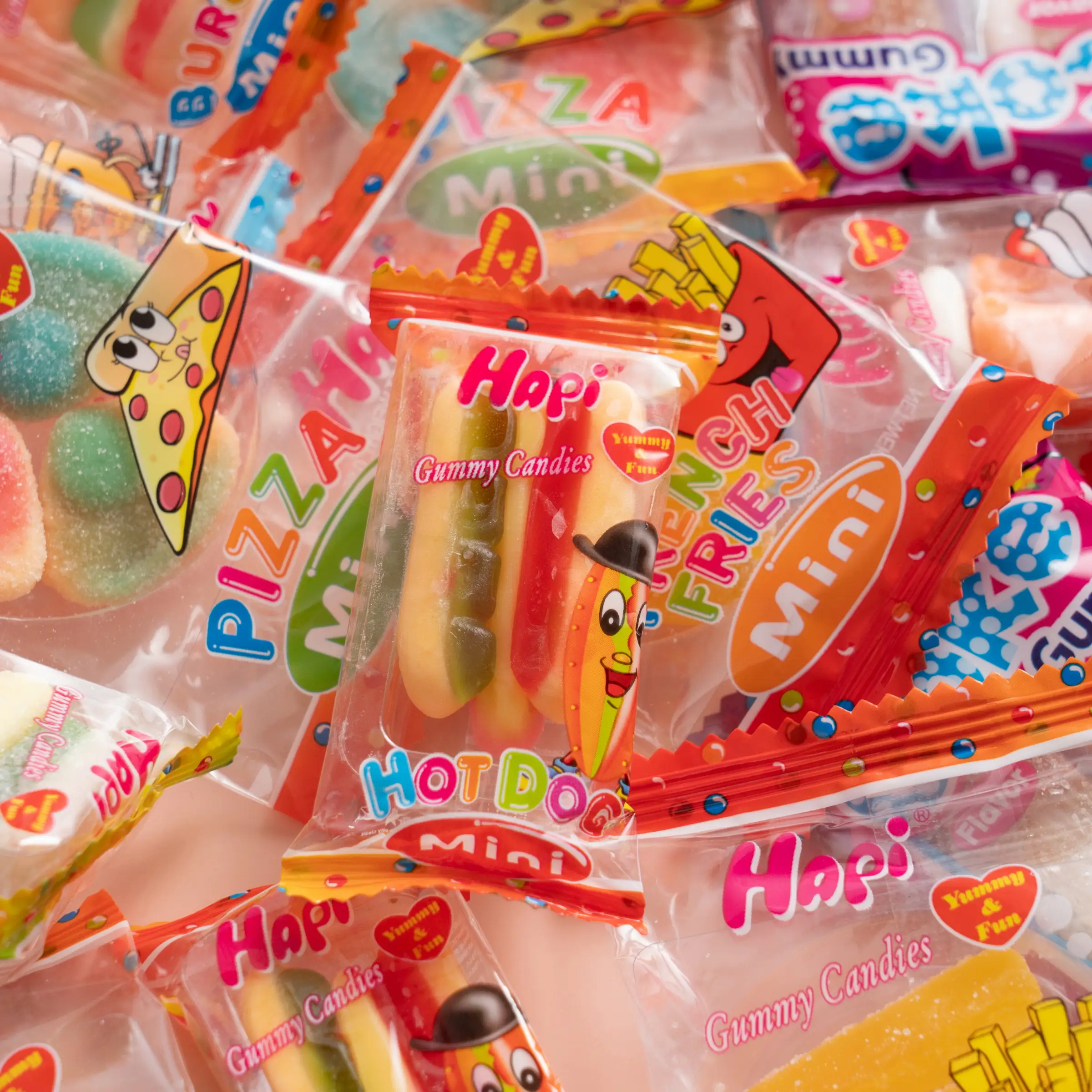
At HAPI, we support custom flavors, shapes, and packaging for business customers. We also provide branded packaging design support, allowing buyers to develop a more consistent product presentation rather than treating the candy and packaging as separate projects.
Evaluate Food Safety and Quality Controls
Quality should be assessed through documented processes rather than attractive product samples alone. FDA food CGMP requirements address areas including employee hygiene, facility conditions, equipment, sanitation, and production and process controls. For food businesses, these controls form an important foundation for consistent and safe manufacturing.
Buyers should ask how incoming ingredients are approved, how production conditions are controlled, and how finished batches are evaluated. Raw material screening is especially relevant because ingredient variation can influence flavor, color, texture, and finished-product consistency.
We apply strict raw material screening before production and operate GMP-certified production lines. Our production approach is designed to keep quality controls connected throughout the manufacturing process instead of relying only on final inspection.
Look Beyond Certificates With Independent Testing
Certifications and internal procedures provide useful evidence, but independent testing can add another layer of verification. SGS, for example, provides food testing covering microbiological, chemical, physical, and sensory parameters, while its confectionery services specifically address buyer requirements related to safety, quality, traceability, and other supply-chain considerations.
For buyers, the key question is not simply whether a factory says that testing is available. Ask what is tested, when samples are collected, which laboratory performs the analysis, and whether reports can be provided for the relevant batch.
Our quality program can include third-party laboratory testing, with SGS or BV testing available. This gives business customers an additional option when independent verification is required for internal quality procedures, customer requirements, or specific markets.
Compare Gummy Manufacturers on Consistency
A successful gummy product needs repeatable characteristics from batch to batch. Texture, flavor intensity, appearance, weight, and other physical properties should remain within agreed specifications. Independent food-testing providers can evaluate physical characteristics such as size, count, defects, foreign materials, viscosity, and weight, demonstrating why quality evaluation can involve more than visual inspection.
Buyers should establish product specifications before placing larger orders. A clear specification can cover approved samples, flavor expectations, shape dimensions, packaging requirements, and acceptable quality criteria. This creates a practical reference for both the buyer and manufacturer during production.
When evaluating gummy candy manufacturers, request samples and discuss how approved samples are used during subsequent production. A supplier’s ability to reproduce an agreed product consistently can be just as important as its ability to create the initial sample.
Assess Compliance and Supply-Chain Reliability
Food safety management should also be considered at the system level. ISO explains that ISO 22000 provides requirements for a food safety management system designed to help organizations identify and control food-safety hazards and demonstrate compliance with applicable requirements.
Buyers should therefore review a manufacturer’s quality documentation, production standards, testing procedures, and traceability practices as part of supplier qualification. It is also useful to clarify how the factory handles changes to ingredients, packaging, or production schedules.
We maintain FDA/ISO-compliant production practices as part of our approach to serving business customers. Our goal is to provide a structured manufacturing process that supports both product consistency and the documentation needs of growing brands.
Check Lead Times Before Placing Orders
Lead time can directly affect inventory planning, product launches, promotions, and seasonal sales. Buyers should distinguish between ready-made products and custom orders because development and production requirements can create different timelines.
We typically arrange ready-made products within 7–10 days, while custom orders generally require 15–25 days. Expedited options are also available for urgent needs. Buyers should still confirm the timeline for each project because customized flavors, shapes, packaging, approvals, and testing requirements may affect the final schedule.
For gummy manufacturers, transparent communication about lead times is an important part of supplier reliability. A realistic schedule is more useful than an aggressive promise that cannot accommodate product development or quality checks.
Make Quality Part of the Buying Decision
Selecting a gummy supplier is ultimately a process of matching manufacturing capabilities with commercial requirements. Buyers should compare customization, quality controls, independent testing, compliance practices, consistency, packaging support, and lead times alongside pricing.
We at HAPI combine custom flavors, shapes, and packaging with branded packaging design support, strict raw material screening, GMP-certified production lines, and optional third-party testing. For businesses looking for gummy candy manufacturers that can support both product development and dependable production, we provide a practical manufacturing route from concept to finished product.