Choosing a confectionery manufacturing partner involves more than comparing quotations. For retailers, distributors, importers, and private-label brands, the right supplier must balance product quality, production capacity, customization options, food safety, and delivery reliability. When evaluating a custom gummy manufacturer, buyers should look beyond attractive samples and low initial prices to understand how well each factory can support product development, repeat orders, and long-term business growth.
A structured comparison helps procurement teams identify potential risks before committing to a supplier. By assessing manufacturing capabilities, quality systems, minimum order quantities, and communication practices, we can make more informed sourcing decisions and build a product range that meets market expectations.
1. Compare Manufacturing Experience and Production Capacity
Manufacturing experience provides useful context when assessing a supplier’s ability to handle commercial orders. Buyers should ask how long the company has worked with confectionery products, which gummy formats it produces, and whether its production systems can accommodate the expected order volume. Experience alone does not guarantee performance, but it helps establish whether the supplier understands the technical and operational requirements of gummy production.
Capacity is equally important. A factory with limited output may struggle to accommodate seasonal demand, while a large facility may not offer the flexibility required for smaller product launches. Ask for the manufacturer’s daily output, available production lines, typical lead times, and procedures for managing demand fluctuations. These details help determine whether its capabilities align with your purchasing schedule.
For example, our manufacturing operations at HAPI build on more than 25 years of confectionery manufacturing experience originating in China, with large-scale operations subsequently established in Vietnam. Our facility features automated gummy production equipment and a fifth-generation starch molding line, with daily capacity reaching 30 metric tons of pectin gummies.
2. Evaluate Customization and Product Development Options
Not every factory can deliver the same degree of customization. Before selecting among custom gummy manufacturers, confirm which product characteristics can be adjusted, including shapes, colors, flavors, textures, ingredients, and packaging formats. If your concept involves layered gummies, three-dimensional figures, or peelable structures, ask whether the supplier has dedicated equipment and relevant production experience.
Also clarify the division of responsibilities during product development. Some manufacturers offer OEM services based on your specifications, while others provide ODM support for developing products around an existing concept. Request sample timelines, revision procedures, tooling costs where applicable, and approval requirements before mass production.
Our dedicated production lines for 3D-shaped and peelable gummies support different product structures, flavors, shapes, and packaging requirements. We provide OEM and ODM services, giving business customers options for developing confectionery products around their target markets and brand requirements.
3. Examine Food Safety and Quality Control Systems
Food safety should be a central part of supplier evaluation, not a final box to check. Ask for current certification documents, details of the factory’s quality management system, and information about how ingredients and finished products are inspected. Depending on your market and product category, you may also need documentation covering ingredient declarations, allergens, shelf life, labeling, and applicable import requirements.
A reliable supplier should be able to explain how it manages production consistency, traceability, hygiene, and nonconforming products. Buyers should verify certification scope and validity rather than relying solely on logos in a brochure. It is also useful to ask how complaints are investigated and corrective actions are documented.
Our manufacturing and responsible sourcing systems are supported by FSSC 22000 and ISO 22000 certification, Disney qualification, and a successful 2025 SEDEX audit. These credentials provide buyers with specific points to review during due diligence. We encourage business partners to assess the relevant documentation alongside their own product specifications and market compliance requirements.
4. Compare Minimum Order Quantities and Total Costs
A low unit price does not necessarily mean a lower overall purchasing cost. When comparing quotations from a custom gummy manufacturer, examine the complete cost structure, including product development, molds or tooling, ingredients, packaging, testing, shipping, and any applicable setup charges. Confirm which services are included in the quoted price and which may generate additional expenses.
Minimum order quantity (MOQ) also affects cash flow and inventory risk. A large MOQ can reduce unit costs but may leave a new product with excess stock if demand is uncertain. Smaller orders can support market testing, although they may carry higher per-unit costs. Buyers should compare suppliers using the same product specifications, packaging configuration, and order volume.
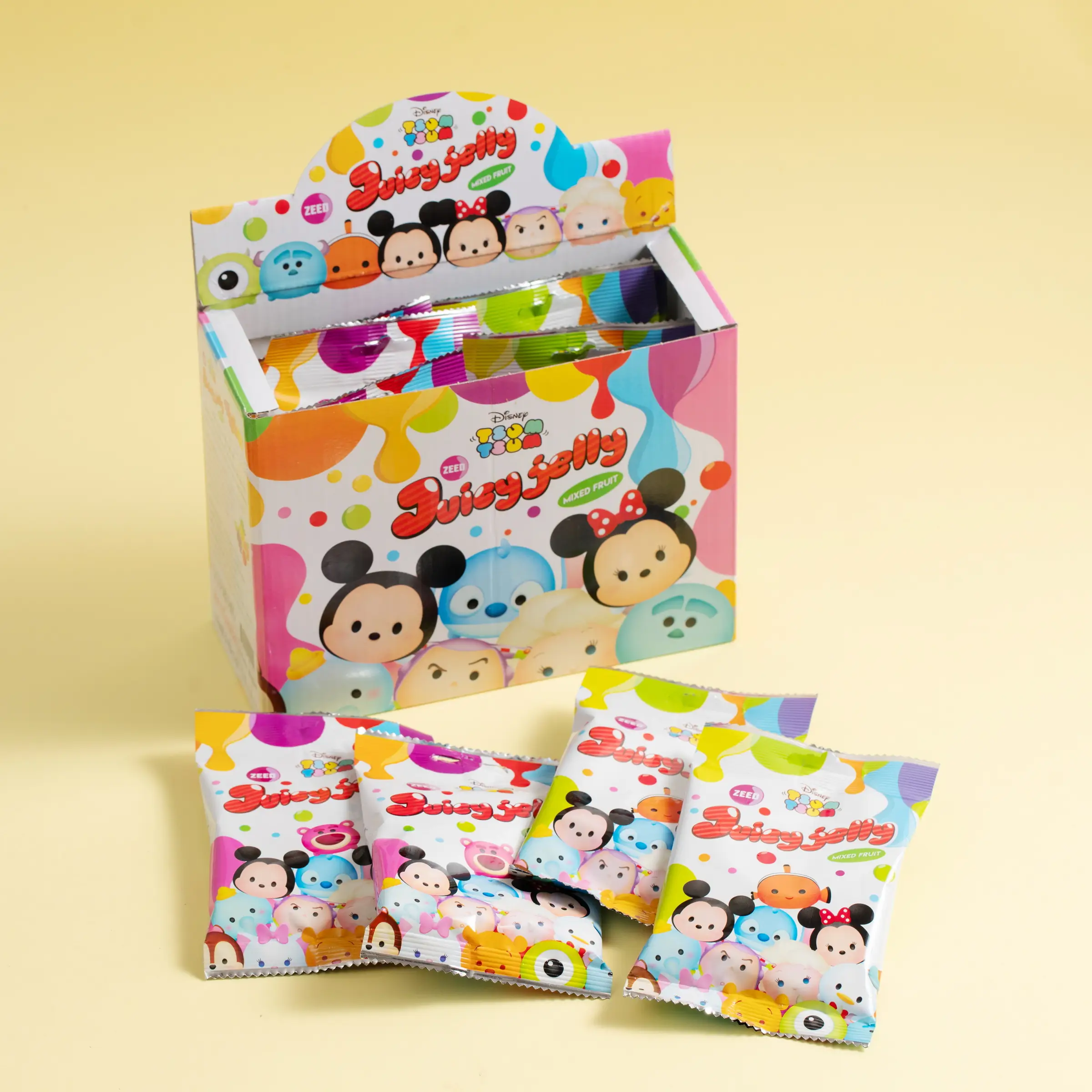
For our 30g Tsum Tsum gummy offering, both OEM and ODM are accepted. The stated MOQ is 1,000 cartons, with each carton containing 12 bags of 350g each. Because this carton configuration differs from the product’s 30g name, buyers should confirm the intended unit weight, bag contents, and final packaging configuration with our team before placing an order.
5. Assess Packaging, Lead Times, and Communication
Packaging affects product protection, shelf presentation, shipping efficiency, and retail suitability. Ask whether the supplier can accommodate your preferred bag sizes, carton specifications, artwork, labeling, and display requirements. Confirm who approves packaging proofs and how changes are handled after production begins.
Lead times deserve the same attention. Request estimated schedules for sampling, artwork approval, production, inspection, and shipment. Clarify how delays are communicated and whether the factory can accommodate repeat orders during peak seasons. Consistent communication is especially valuable when buyers operate across different time zones or manage multiple sales channels.
When comparing custom gummy manufacturers, evaluate how clearly each supplier answers technical questions, documents decisions, and responds to changes. A detailed quotation and realistic production schedule are more useful than broad assurances that every requirement can be met.
6. Check Scalability and Long-Term Partnership Potential
A supplier should meet current requirements while leaving room for future product development. Consider whether its equipment, workforce, and production planning can support larger orders, new shapes, additional flavors, or packaging updates as your business grows. Ask how repeat-order specifications are maintained and how product consistency is monitored across batches.
It is also worth examining the supplier’s experience serving international customers and supporting OEM or private-label projects. Export documentation, communication practices, and an understanding of destination-market requirements can influence the efficiency of cross-border purchasing. Request relevant examples or supporting documents where appropriate rather than relying on general promises.
The purpose of comparing custom gummy manufacturers is to identify a partner whose documented capabilities, quality systems, commercial terms, and working practices fit your business model—not simply to select the lowest quotation.
Make Your Gummy Sourcing Decision With Clear Criteria
A practical supplier comparison should cover manufacturing capacity, customization, food safety, MOQ, total cost, packaging, lead times, and long-term scalability. Use the same questions and product specifications for each candidate, then verify important claims through documentation, samples, and direct discussions.
At HAPI, we support OEM and private-label confectionery projects, combining established manufacturing experience with automated production capabilities and dedicated gummy lines. Contact our team to discuss your product concept, packaging requirements, and order volume so we can explore a suitable manufacturing solution for your business.